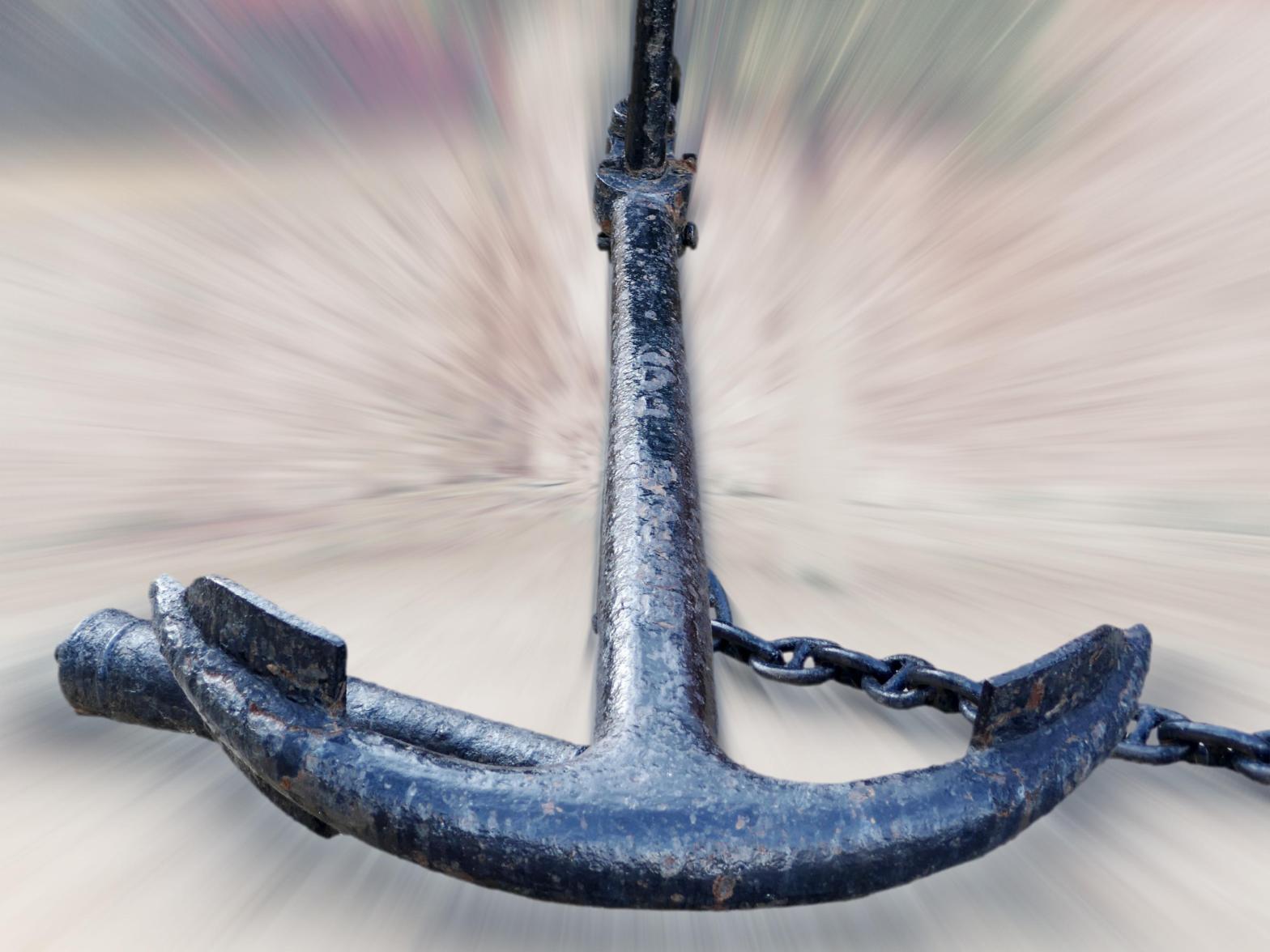
If you’ve ever gone fishing, you know that once you find a good location, you want to stay there. So, you often drop an anchor in the water, to keep your boat from drifting away.
Communications anchors can help in much the same way when you communicate to the public. They are language “devices” that help you explain complex topics in relatable ways. They also help keep your audience on track as you navigate your explanations.
Analogies
One of the best types of anchors I like to use is an analogy. Analogies give an audience a common idea to hold onto when learning new things (like my fishing example in my lead to this section!) Analogies tell your listener that your research is like something from their daily life.
I work with some very clever writers and scientists. Here are some examples of analogies we’ve used:
- Riparian buffer zones are like hydraulic shock absorbers
- Phenotyping gives us information about plants just like our exercise devices (Apple Watch, Fitbit, Garmin) do for us
- Denitrifying bioreactors are like water filters used in our homes
- Genotyping maps are organized the way librarians organize books
- Double bonds are a like a two-handed handshake
- Chemistry is like putting puzzle pieces together in different ways
A note about analogies – they need to be relevant to your audience. I recently worked with a scientist who compared a seed buried in soil as being inert to heat, like a spaceship entering the earth’s atmosphere from orbit. As an older adult, I got this analogy 100%. However, my younger coworkers didn’t. They were not watching television when the spaceships and shuttles took off and landed. So, why would they understand a heat shield on a spaceship. A better analogy in this case might be a firefighter’s safety gear, an oven mitt, or anything that protects from extreme heat.
Key words
There are also key words that help with leads. Using “active verbs” is a more engaging way to communicate. (I hope that didn’t make you flash back to your middle school English teacher – but really, this is important, so please stick with me. Also, I love English teachers!)
We are trained in writing scientific papers to write things like “Fisk et al found in 1982 that…” Or the common “research has shown that…” That’s great for peer-reviewed journals, but awful for public communications.
So, active verbs:
Helping * Improving * Decreasing * Increasing * Healing
Note that none of these words fall in the “jargon” category – like remediating, mitigating, etc., because that would break our “no jargon” rule of science communications.
Other good key words are adjectives–words that describe nouns.
Potential * Successful * Prosper
Are you looking for potential solutions to decrease greenhouse gases? Researching potential cures to help a certain disease? Studying ways to make batteries more efficient? Working to help farmers prosper despite a changing climate? Those are positive, relatable statements.
Physical demonstrations
When you are working with video or live public communications, you have an opportunity to do a physical demonstration.
Example: Let’s say you are working at field days and can’t have a PowerPoint slide behind you. You are talking about soil compaction – in the field, in gardens. Show with your hands that roots can grow easily in upper, uncompacted layers, but not in lower compacted areas.
Example: You’re researching ways to make a new chemical compound. You want to add a hydroxyl group (-OH for non-chemists) to an existing compound to see if it increases an effect in clinical research. Pretend you are the original compound and have an object like a pen or your cell phone nearby. Say the object represents the hydroxyl group, and “add” it to yourself – that’s the goal of your work!
Anchors help your audience understand your topic. They also show your audience that you are trying to work with them in your communications efforts. When scientists meet the public closer to their comfort level it starts to build the necessary trust that will improve relationships on all sides!
If you’re willing to share your great communications anchors email me at the address below or place a comment and we’ll get that shared with the #SciComm community!
Written by Susan V. Fisk, BS(Chem), M.Ed., MBA. Copyright by author.
Read more blogs about writing:
Communicating so people understand (Readability)
Read more about photography: Importance of taking photos to document your scientific work.
Tips on what type of photos to take.
Do you want more help with your science communications? Contact me at TrulyRelatableScience@gmail.com for estimates on editing your professional web pages, public presentations, grant proposals, or to Zoom into your classroom/lab for a workshop!
 Relatable Science
6 thoughts on “Toss your audience an anchor!”