Nowhere in my scientific training did anyone explain to me that communications went further than publishing a paper or presenting to my peers. Every Monday night, graduate students participated in a seminar of quickly synopsizing papers we’d read over the weekend. Ok, we really read them Sunday night – or even the wee hours of Monday! In return, we were fed pizza. Our job was to demonstrate knowledge by paraphrasing other researchers’ published papers.
This was in the early 1980s. Even forty years ago, research papers were easier to read than they are now:
The readability of research papers has decreased from 1881-2015, says a study on 123 scientific journals. 1 “Lower readability implies less accessibility, particularly for non-specialists, such as journalists, policy-makers and the wider public.”
This decrease in readability for scientists flows directly into decreased understanding by the public. But scientists are not helpless in the communications situation before us! There are steps we can take to improve communications.
Sending a message doesn’t mean it’s received correctly. Humans are entirely complex beings! Today even communications is more complex – due to the number of ways people can get their information (or misinformation). Let’s look at what’s involved in communications because it’s so much more than “just stating facts.”
The participants – sender and receiver
In a simple communications diagram, there is a sender (you) and a receiver (your audience). You have a message, which you state. They receive it. Do they understand it? How do you know? You thought your message was clear, but you made many assumptions in doing so.
You assumed each word was understandable by your receiver/s. You assumed they were ready to hear the message. You assumed they were not distracted.
If your receiver is a co-worker and you are engaged in an active conversation in person, these assumptions are fairly safe. When you are speaking to larger groups, like at a scientific meeting, it’s a bit harder to know if an audience full of colleagues all picks up your message the same way. You are speaking to colleagues who are perhaps distracted and tired. And it’s a one-way conversation, usually, at these types of presentations. Most of the time, your message is received well. But do you test that by asking questions? We usually don’t have time, do we?
When you’re communicating with the public, especially online with no visual clues, assumptions of understanding are most likely inaccurate. You do control the message you send, and if you do the work to make it the most relatable, you’ll be more successful.
Between the sender and the receiver there are still lots of variables that can interfere with your message, no matter your audience. And understanding these factors is important to understanding why we must work on our messages. Please refer to my figure as we move along in this idea.
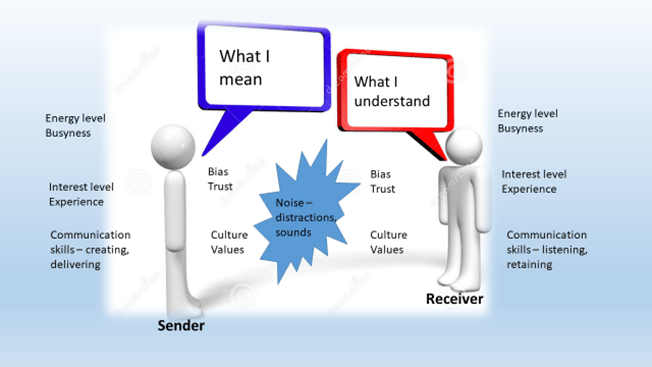
Noise: besides needing to make sure your message is understandable it’s important to realize that all our messages are competing with “noise.” Just because you have made a very clear and compelling message doesn’t mean the receiver/s understand. Most of the public who is listening or reading your science communication is doing it on their own time. They may also be cooking dinner (or thinking of what to pick up at the store in their mind). There are many distractions these days, which is why working on your message is so important.
Bias: everyone has bias. Even you. That is one of the filters of all messages coming into our brains. The best way to overcome bias is to connect with your audience before starting your message if it’s a synchronous activity. Ask your audience a few questions about themselves before starting your talk. If someone has an issue with scientific knowledge changing, I’ve written a blog about uncertainty that you can lean on for tips to manage this.
If you’re online, like this blog, it’s best to start your blog with an intended audience. In my case, I’m writing for Bachelor’s to Doctorate level scientists currently working in the field or educating about science!
Example: Covid-19 has given us one of the best examples of good and bad science communications. Let’s face it: most people don’t understand data sets. They don’t understand mRNA and how it’s different from DNA. Should they? It’s my strong opinion, that no, your average person has gone through life just fine until this global pandemic having forgotten mRNA. So scientists need to start with compassion (dropping our own bias) and be up front, like Dr. Fauci, that as more cases happen, that helps us gather more information. And that new information can change our recommendations. Again, uncertainty. Scientists are used to it, even if we don’t like it. Also, it’s a scary time! I know I very much appreciated the infographics provided by the CDC to help explain best practices for “regular folks.”
Trust – hopefully, you have earned the trust of your coworker. But how well do other receivers know you? That’s why there is a value in getting to know your audience – it helps you understand them and is a trust-building exercise. Just because you have “X” years of study does not mean you have trust with your audience.
Example: One of the best ways to clarify your position as an expert is not your degree, or where you work, but in stating that you are speaking about information published in a peer-review journal. The public has come a long way in understanding the value of peer-review, which lends a lot of credibility to your message. You can even go so far as to state why you value the peer-review process, which can create some common values with you and your listener/s.
Example: Although we might think being a scientist creates immediate credibility, if your receiver/s isn’t coming from that angle – what else do you have in common? Are you a parent, too? Or have siblings you’d like to keep safe? Aiming at a common value and communicating from there can help here.
Culture and values – related to bias, culture and values are also “owned” by everyone. And both effect what you can say, how you can act – or at least these attributes are implied.
Example: Having lived in several places in the United States, I’m still limited in my cultural understanding. But I can tell you that there’s a huge cultural difference between New Orleans pre-game football food and Green Bay pre-game football food! So, if you were speaking to a group in New Orleans, you might use an analogy based on a beans-and-rice topic, and in Green Bay, it would be more dairy (and cheese) focused topic.
Energy level – is your receiver tired? That will completely change their ability to understand your message. That’s why making content relatable is so important.
Example: Your physical presence can be key here. The more energy you put across, the more your receiver will receive. If you are in person, is there a way to have people move around? Stand up a bit? If you’re online, keep your sentences short, and have many analogies and examples!
Interest level – hopefully, your co-workers are interested in your work. But we must work hard to make our scientific practices and findings into compelling, interesting public messages. You must get straight to the point to get peoples’ attention. This is why communicating with a great lead and anchors is so important. And remember to not use jargon – that’s an easy way to lose attention.
Experience level – You, of course, are very experienced with the science you practice. But most people are not. Where does your work overlap with the public. Food? If you’re a chemist, and you find many in your audience are interested in cooking, use recipes as an example. Or if you work in biology, bring up bakers yeast. Cars? What facet of a car overlaps with your work? Headaches? Hopefully you don’t have many of these, but if you work with any type of meter, your audience may be able to relate to an intense headache (high meter reading) versus a low one. Use these commonalities in your analogies and examples. These may seem like simple things, but all these experiences are important in explanations, because a term “out of context” may not be understood – no matter how learned and experienced your audience may be.
Example: Photos can certainly help here. And not the picture-perfect photo, though that doesn’t hurt. Bringing some samples and letting the audience have a hands-on activity could also help with this type of communication hurdle.
Listening experience – hearing or reading a message is hard work. And some people are better at listening than others. Listening takes energy, time, experience. This also goes along with learning style. People can be mixes of oral, visual or experiential learners. I myself learned very little from lectures, so taking my own notes (visual) and reviewing them helped me learn. That’s why using photos and activities (experiential) can help reach all types of learners.
Read here to learn more characteristics of audiences (online or in-person) and how to use this knowledge to make your communications better!
Written by Susan V. Fisk, BS(Chem), M.Ed., MBA. Copyright by author. @susanvfisk (Twitter, IG) Be sure to subscribe to my blog to get the latest updates and thank you for reading!
Do you want more help with your science communications? Contact me at TrulyRelatableScience@gmail.com for estimates on editing your professional web pages, public presentations, grant proposals, or to Zoom into your classroom/lab for a workshop!
 Relatable Science
One thought on “Why is science communication so hard?”